Almost every file-sharing tool advertises “encryption” somewhere on its homepage, which makes the word nearly meaningless on its own. Encrypted from what, exactly? There's a real, practical difference between a file that's encrypted and a file that only you can actually read and it comes down to one question: who holds the key?
“Encrypted” doesn't automatically mean private from everyone
Most file-sharing services encrypt your files in transit (while uploading) and at rest (while stored on their servers), usually with a standard like AES-256. That's genuinely good practice, and it protects you from someone intercepting the file mid-transfer or grabbing a raw copy off a disk. But in this setup, the provider holds the decryption key on their end which means they, or anyone who compromises their systems, could technically unlock and read your files. The encryption protects the file from outsiders. It doesn't protect it from the provider itself.
What changes with end-to-end encryption
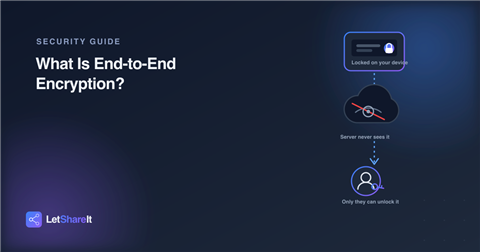
End-to-end (sometimes called zero-knowledge) encryption moves the lock to before the file ever leaves your device. It's encrypted locally, uploaded as unreadable ciphertext, and stored that way the provider never has a copy of the key and never has a way to decrypt it themselves. Only you, and whoever you share the access with, can unlock it. If the provider's servers were ever breached, what an attacker would get is noise, not your files.
Why the distinction is worth knowing
- Breach protection that actually holds up. Server-side encryption keeps a casual snooper out. End-to-end encryption keeps the provider itself out too so a breach of their systems doesn't expose your content, just unreadable data.
- It matters more for certain files than others. Contracts, financial records, medical documents, unreleased creative or product work anything where “only the intended recipient can read this” is the actual requirement, not just a nice-to-have.
- It's a different trust model, not just a stronger lock. With server-side encryption, you're trusting the provider to protect the key responsibly. With end-to-end encryption, there's no key on their side to protect you're not trusting their judgment, you're removing the need to.
How to tell which one you're actually getting
A quick way to check: ask what happens if you lose your password. If support can reset it and still hand your file back, the provider had a way to decrypt it all along that's server-side encryption, whatever marketing language sits on top of it. With genuine end-to-end encryption, losing the key means the provider can't recover it for you either, because they never had it. That inconvenience is the proof.
Where it doesn't matter as much
Not every file needs this level of protection. A public press kit, marketing assets, a portfolio reel meant for anyone to see these are built to be shared openly, and standard encryption in transit and at rest is already more than enough. Save end-to-end encryption for the files where it would actually be a problem if the wrong person, including the provider, could read them.
What this looks like on Letshareit
Every file on Letshareit is encrypted with AES-256, in transit and at rest, as a baseline on every plan. On Pro and Team plans, that steps up to client-side encryption your files are encrypted before they leave your device, and even Letshareit can't read their contents. For anything that genuinely needs to stay between you and the recipient, that's the tier worth being on.